Easy Application Epoxy Potting Compound Glue Electronic Epoxy Resin Adhesive High Thermal Conductive Potting Epoxy Adhesive
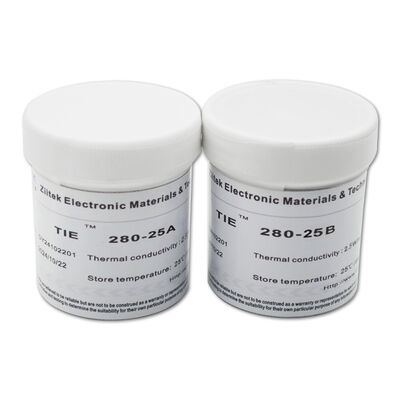
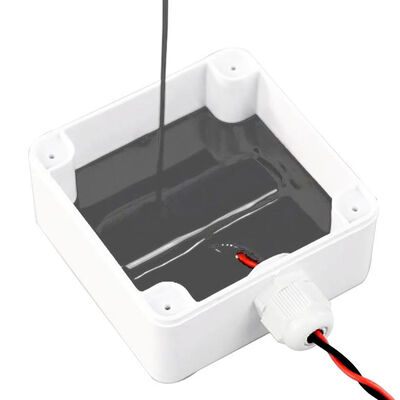
TIE®280-25AB is a two-component epoxy resin sealantwithgood thermal conductivity and room temperature curing properties. It can complete the curing process at room temperature and is convenient for on-site operation and construction. And this material has excellent fire and flame retardant properties, which can meet the high safety requirements of electronic devices.It is particularly suitable for the sealing protection of capacitors,small electronic components,and precision circuit modules,and can provide long-term reliable mechanical support and environmental protectionfor sensitive components.
Features
> Good thermal conductive: 2.5W/mK
> Excellent insulation and smoothly sourface.
> Low shrinkage
> Low viscosity, expediting air releaseed.
> Excellent in solvents and water proof.
> Longer life time.
> Excellent thermal shock efficiecy and impact resistance
Application
> Automotive starters potting; General potting Thermal detector potting
> Ferrite adhesion; TIP type LED; Good adhesion to aromatic polyester
> Relay sealant; Good adhesion to rubber, ceramics PCB and plastics
> Power transformers and coils; Potting capacitors Potting of small electrical devices
> Adhesion to metal glass and plastic LCD & substrates adhesion; Coating and sealant; Coil ; IGBTS; Transformer; Fire retardant
> Optical / medical component adhesive
| Typical Properties of TIE®280-25AB Series |
| Uncured Material Properties |
| Property |
Value |
Test Method |
| Construction |
Epoxy resin |
- |
| Color/Part A |
Black |
Visual |
| Color/Part B |
Gray |
Visual |
| Part A Viscosity (mPa·S) |
50,000 |
ASTM D2196 |
| Part B Viscosity (mPa·S) |
30,000 |
ASTM D2196 |
| Mix Ratio |
1:1 |
- |
| Shelf life (Month) |
12(Unopened) |
- |
| Cure Schedule |
| Cure @ 25°℃ |
6 hours |
Ziitek Test Method |
| Cure @ 70°C |
35 mins |
Ziitek Test Method |
| Cure @ 100℃ |
15 mins |
Ziitek Test Method |
| Cure Material Properties |
| Color |
Gray |
Visual |
| Density(g/cm³) |
2.0 |
ASTM D792 |
| Hardness (Shore D) |
85 |
ASTM D2240 |
| Breakdown Voltage (V/mm) |
≥10,000 |
ASTM D149 |
| Dielectric Constant @1MHz |
4.2 |
ASTM D150 |
| Volume Resistivity (Ohm·cm) |
>1.0x10¹² |
ASTM D257 |
| Thermal Conductivity (W/m·K) |
2.5 |
ASTM D5470 |
| Recommended Operating Temperature (℃) |
-40~160 |
- |
| Flame Rating |
V-0 |
UL 94 |

Instruction For Use
1. Mixing
Resin is prone to sedimentation and stratification during transportation or storage; therefore, it must be thoroughly stirred before use.Weigh the resin (Part A) and curing agent (Part B) accurately according to the recommended mixing ratio, then pour them into a clean container for blending. The weighing equipment shall meet the accuracy requirements to ensure the ratio is precise and error- free. lf the ambient temperature is below 18℃, it is recommended to preheat Part A in an oven at 50℃ for 45 minutes to improve the fluidity of the mixed adhesive.
Caution: The preheating temperature during mixing is strictly prohibited to exceed 50℃, as high temperatures will drastically shorten the working life of the adhesive.First, stir manually for 2-3 minutes. During the stiring process, continuously scrape the bottom and inner walls of the container to ensure the adhesive is mixed uniformly. If conditions permit, perform additional mechanical stiring for another 2~3 minutes. High-speed operation shall be avoided during stirring to prevent air bubble generation or further shortening of the adhesive's working life caused by frictional heating.
2. Vacuumizing
To completely remove the air bubbles mixed into the adhesive during stirring, it is necessary to perform vacuum degassing treatment on the blended adhesive.Set the vacuum degree to.1-5 mmHg. During the vacuumizing process, air bubbles inside the adhesive will continuously precipitate and float to the surface. Maintain the vacuum until the bubbles are basically eliminated; the degassing time is generally 3-10 minutes.
3. Application
Inject the blended and degassed adhesive into the target mold. Moderate preheating of the mold can reduce the adhesive viscosity and improve its fluidity, ensuring the adhesive fully encapsulates all areas of the coils or assemblies to be potted.For application scenarios with high requirements for encapsulation compactness and reliability,it is necessary to conduct a second vacuum treatment after glue injection to completely eliminate residual bubbles inside the adhesive and at the contact surfaces between the adhesive and the assemblies.The curing process can be performed in accordance with the recommended curing procedure specified in the product documentation. To further enhance the adhesive's bonding strength, compactness and weather resistance, it is recommended to carry out an additional post-curing process with heating after the completion of initial curing. Post-curing can generally be conducted at the maximum curing temperature specified in the product specification sheet, with constant-temperature baking for 2~4 hours; alternatively, the curing process parameters can be adjusted according to actual application requirements.
Application Considerations
Please read the safety and health-related technical documents carefully prior to use, and strictly comply with all requirements specified in the product labels and safety data sheets.To ensure the long-term stable performance and reliability of the electronic encapsulated assemblies, it is necessary to perform thorough cleaning of the component surfaces to remove attached contaminants such as dust, moisture, salts and grease before each potting operation.Such impurities are prone to causing quality defects including short circuits, insufficient bonding strength and substrate corrosion after encapsulation, which will seriously impair the service life of the products.
Storage Guidelines
The resin and curing agent shall be stored in original sealed containers and placed in a cool and dry area, which can effectively extend the product shelf life. Storage methods and ambient temperature are key factors affecting the product shelf life, and must be strictly followed as required
Compatibility
Certain chemicals, such as plasticizers in the curing agent, may inhibit the curing of this product. This issue can be resolved by cleaning the substrate surface with a solvent or performing slight baking at a temperature slightly higher than the curing temperature. Special attention should be paid to the following materials:Organic substances containing elements such as N, P and S, and ionic compounds containing metal ions such as Sn, Pb, Hg, Bi and As. Alkyne and polyvinyl-containing compoundsCondensation-type adhesives, as well as molds and tools contaminated by such adhesive.
Safety/Hygiene
Similar to other resin-based products, this product is irritating to human skin and eyes. Some individuals may experience allergic reactions characterized by skin rashes and itching after skin contact with this product or inhalation of its volatile vapors. In high- temperature operating environments, it may also trigger respiratory odor hypersensitivity.
Special Warning: Component B (curing agent) is corrosive. Direct contact with skin or eyes can cause chemical burns. Some divagctvva symptoms including rashes, itching and dificulty breathing.A comprehensive set of hygiene and safety protection measures must be established during the handling of this product.
Operators shall wear safety goggles and chemical protective clothing to avoid direct contact with the product. For details on engineering control schemes, selection of personal protective equipment and emergency response measures after accidental contact, please refer to the Product Safety Data Sheet (SDS).
Company Profile
Ziitek company is a high-tech enterprise dedicated to the R&D, manufacture and sales of thermal interface materials (TIMs). With rich experience in this field, we provide the latest, most effective one-step thermal management solutions. Our facility includes advanced production equipment, full test equipment, and fully automatic coating production lines capable of manufacturing high performance thermal products including:
Thermal gap pad
Thermal graphite sheet/film
Thermal double-sided tape
Thermal insulation pad
Thermal grease
Phase change material
Thermal gel
All products are compliant with UL94 V-0, SGS and ROHS standards.
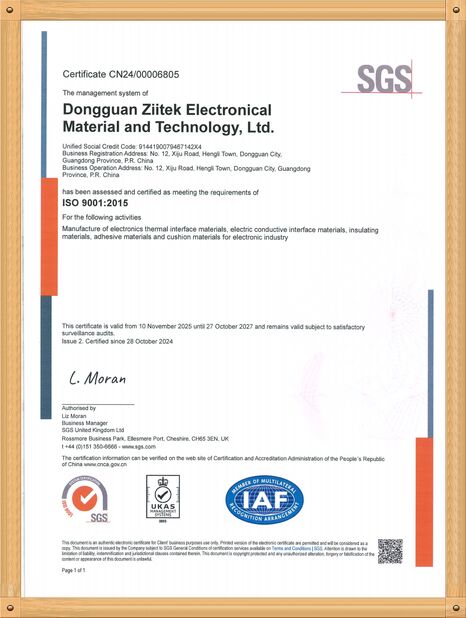
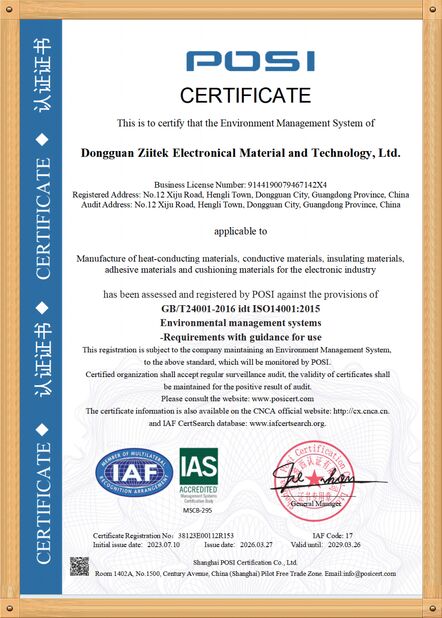
Certifications: ISO9001:2015, ISO14001:2004, IATF16949:2016, IECQ QC 080000:2017, UL


 Your message must be between 20-3,000 characters!
 English