|
Product Details:
|
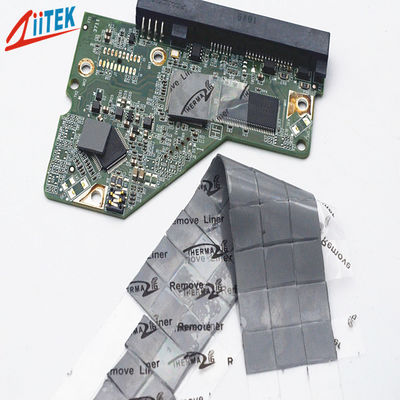
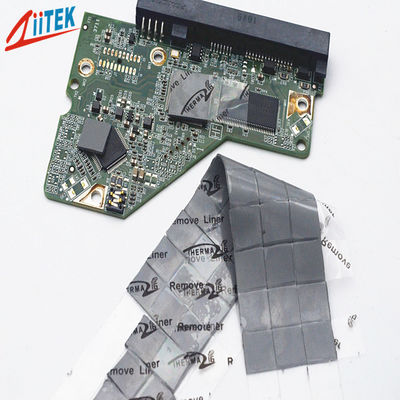
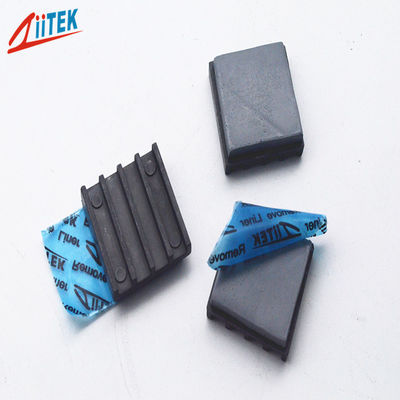
| Products Name: | 1.0mm Thickness CPU Thermal Pad High Thermal Conductivity Thermal Gap Filler Pad For AI Server | Fire Rating: | 94 V0 |
|---|---|---|---|
| Thickness: | 1.0mmT | Color: | Gray |
| Keyword: | CPU Thermal Pad | Hardness: | 75 Shore 00 |
| Application: | AI Server | Sample: | Free |
| Highlight: | fire proof heat insulation silicone pad,1.0mm heat insulation silicone pad,1.0mm silicone thermal pad |
||
The TIF®120-20-10UF Series is a structurally supportive thermal pad designed to provide effective heat dissipation while ensuring structural support and durability. It reliably fills interface gaps, transfers heat, and offers mechanical support for stacked components, resisting compressive deformation. This product is an ideal choice for applications that require a balance between heat dissipation, insulation, and mechanical stability.
| Property | Value | Test Method |
|---|---|---|
| Color | Gray | Visual |
| Construction & Composition | Ceramic filled silicone elastomer | ZKTM J024 |
| Density (g/cm³) | 2.8 | ASTM D792 |
| Thickness Range (inch/mm) | 0.010~0.200 / 0.25~5.00 | ASTM D374 |
| Hardness (Shore OO) | 75 | ASTM 2240 |
| Recommended Operating Temperature | -40 to 200°C | ZKTM J025 |
| Breakdown Strength (V/mm) | ≥5500 | ASTM D149 |
| Dielectric Constant @1MHz | 6.5 | ASTM D150 |
| Volume Resistivity (Ohm-cm) | >1.0×10¹² | ASTM D257 |
| Flame Rating | V-0 | UL 94 (E331100) |
| Thermal Conductivity (W/m-K) | 2.0 | ASTM D5470 |
| Thermal Conductivity (W/m-K) | 2.0 | ISO 22007 |
Standard Thickness: 0.010" (0.25 mm) – 0.200" (5.00 mm) with increments of 0.010" (0.25 mm).
Standard Size: 16" × 16" (406 mm × 406 mm).
The TIF series is available in custom shapes and various forms. For other thicknesses or more information, please contact us.
A: TIM (Thermal Interface Material) refers to a class of materials used to fill microscopic air gaps between a heat source and a heat sink. TIMs help reduce interface thermal resistance and improve heat transfer from the heat source to the cooling structure. Common TIMs include thermal pads, thermal gels, thermal greases, phase change materials (PCMs), and liquid metal.
A: Thermal conductivity indicates a material's ability to conduct heat and is typically measured in W/m·K. Under the same testing conditions, a higher thermal conductivity generally indicates better heat-conduction capability.
A: Thermal resistance indicates the resistance to heat flow through a material or interface and is typically expressed in K/W or °C/W. Lower thermal resistance generally means that heat can pass through the material more efficiently.
A: Thermal conductivity primarily reflects the intrinsic heat-conduction capability of a material, while thermal resistance is also affected by factors such as thermal conductivity, material thickness, contact area, and interface conditions. In practical applications, it is important to consider not only thermal conductivity but also the overall thermal resistance of the TIM layer.
Contact Person: Dana Dai
Tel: +86 18153789196